
Every parent wants to see their child succeed at school.
You want them to walk into the classroom with confidence, make good friends, respect their teachers, and believe in themselves when challenges arise. While good grades matter, they tell only part of the story. The habits that shape a child’s future—focus, resilience, discipline, confidence, emotional control, and respect—often determine how they respond to opportunities and setbacks throughout life.
That’s why so many parents choose martial arts.
At Arashi-Do Martial Arts, we certainly teach children how to kick, punch, grapple, and defend themselves. But the greatest transformation doesn’t happen because of the techniques they learn. It happens because of the person they become while learning them. Every class challenges children to focus, overcome obstacles, work with others, and push past self-doubt. Over time, those experiences build habits that carry into the classroom, the playground, and eventually the workplace.
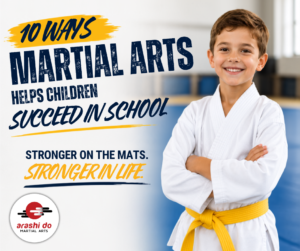
Here are ten ways martial arts help children become stronger students, more confident young people, and future adults who believe in themselves.
1. Martial Arts Builds Focus in a World Full of Distractions
Children have never faced more distractions than they do today. Smartphones, tablets, streaming services, video games, and social media constantly compete for their attention. Even at school, many children struggle to stay engaged because their brains have become accustomed to constant stimulation and instant rewards.
Martial arts train the opposite habit.
From the moment your child steps onto the mats, they must become fully present. They watch demonstrations closely, listen carefully to instructions, remember combinations, and respond to changing situations. Every drill demands attention. Every technique requires concentration. If their mind wanders, they miss important details. When they stay focused, they improve.
Those repeated moments of concentration strengthen the same mental muscles children rely on every day in the classroom. Instead of trying to force focus, they begin practicing it several times each week in an environment that rewards attention and effort.
Many parents notice these changes long before report cards arrive. Homework becomes less of a struggle. Teachers comment that their child listens more carefully during lessons. Following multi-step instructions becomes easier, and distractions have less power over them. Focus isn’t a personality trait that some children simply have while others don’t, it develops through consistent practice, and every class gives children another opportunity to sharpen that skill.
2. Your Child Earns Confidence That Lasts
Every parent wants their child to feel confident, but confidence doesn’t come from hearing praise alone. It grows through experience. Children build genuine self-confidence when they face something difficult, work through the challenge, and discover they can succeed.
Martial arts creates those opportunities every single class.
Your child won’t master every technique the first time they try it. They’ll lose their balance, forget combinations, struggle with coordination, and occasionally feel frustrated. Instead of lowering the standard or avoiding the challenge, instructors coach them through the process. They practice, make adjustments, and improve one step at a time.
Those small victories begin to reshape how children see themselves. They stop worrying about whether they’re “good enough” and start trusting their ability to learn.
That confidence doesn’t stay inside the dojo.
It follows them into school when they raise their hand to answer a question, volunteer for a classroom presentation, introduce themselves to a new classmate, or join an activity they might have avoided in the past. Instead of fearing mistakes, they understand that mistakes simply mark the beginning of learning.
Real confidence doesn’t mean believing you’ll never fail. Real confidence means believing you’ll figure things out because you’ve already done it before.
3. Every Class Strengthens Self-Discipline
Children live in a world that encourages immediate results. If something feels difficult, entertainment is only a click away. Developing self-discipline has become harder than ever because children rarely need to wait, practice, or persist before receiving a reward.
Martial arts teaches a completely different lesson.
Every stripe, every belt, and every achievement represents consistent effort. Your child earns progress by showing up regularly, listening carefully, practicing intentionally, and giving their best effort, even when a technique feels challenging. They quickly realize that improvement doesn’t happen overnight. It happens because they continue showing up, even when progress feels slow.
That lesson extends far beyond the mats.
Children who experience the connection between effort and improvement often begin applying the same mindset to school. Homework no longer feels like something to avoid but another opportunity to improve. They become more willing to finish difficult assignments, take responsibility for chores, organize their schoolwork, and stick with long-term goals because they’ve experienced the rewards of consistency.
Discipline isn’t about forcing children to obey rules. It’s about helping them develop the habits that allow them to achieve the goals they set for themselves.
4. Respect Becomes Part of Who They Are
Respect isn’t something children develop by listening to lectures. They develop respect by practicing it every day.
Every class reinforces respectful behaviour through meaningful actions. Your child bows before entering the training area, listens while instructors teach, waits patiently for their turn, thanks training partners after drills, and encourages classmates who are still learning. These behaviours happen so consistently that they eventually become habits rather than rules.
Just as importantly, instructors model respect in return. They challenge students while encouraging them. They correct mistakes without embarrassment. They celebrate effort as much as achievement. Children learn that respect creates trust, and trust creates an environment where everyone feels safe to learn.
Those habits naturally carry into other areas of life.
Teachers appreciate students who listen attentively and contribute positively to the classroom. Classmates enjoy working with children who treat others with kindness and patience. Parents often notice conversations at home becoming more respectful as children learn to communicate with greater maturity.
Respect isn’t about demanding obedience. It begins with understanding that every person deserves kindness, patience, and consideration.
5. Your Child Learns to Push Through Challenges
Every child faces moments when something feels too difficult.
Some struggle with reading. Others find math frustrating. Some become discouraged after receiving a disappointing test score or making a mistake in front of their classmates. Without the right mindset, those experiences can convince children that they simply aren’t capable.
Martial arts interrupts that thinking.
Every class presents challenges that students can’t solve immediately. A new kick may feel awkward. A Brazilian Jiu-Jitsu technique may require several attempts before it clicks. A kata may seem impossible to remember.
Instead of avoiding the challenge, your child learns to work through it.
Instructors break techniques into manageable steps, provide encouragement, and help students celebrate progress instead of perfection. Over time, children begin expecting challenges rather than fearing them because they’ve experienced what happens when persistence replaces frustration.
That mindset transforms how they approach school.
Instead of saying, “I’m not good at math,” they begin asking, “Can you explain it another way?” Instead of giving up on a difficult assignment, they understand that improvement often happens just after the point where most people quit.
Children who learn to persevere become children who believe they can overcome almost anything.
6. Physical Activity Strengthens Both Body and Mind
Children weren’t designed to spend most of their day sitting at a desk.
Their bodies need movement, and their brains benefit from it. Regular physical activity supports healthy brain development, improves mood, reduces stress, increases energy, and helps children maintain the attention they need to learn effectively throughout the school day.
Martial arts offer far more than exercise.
Every class combines physical movement with problem-solving, memory, coordination, timing, and decision-making. Your child constantly learns new skills while improving strength, flexibility, balance, and body awareness. They challenge both their muscles and their minds at the same time.
Parents often notice positive changes that extend well beyond fitness.
Children sleep more soundly. They have more energy during the day. They manage stress more effectively and return home from class feeling calmer, happier, and more balanced. Physical confidence often improves emotional confidence as well because children begin feeling stronger, healthier, and more capable in everything they do.
Healthy bodies support healthy minds, and martial arts help children strengthen both.
7. Goal Setting Stops Feeling Overwhelming
Many children struggle with large goals because they only see the finish line.
Martial arts teaches them to focus on the next step instead.
Every belt represents dozens of smaller accomplishments. Students don’t become advanced martial artists overnight. They improve one class, one technique, one stripe, and one belt at a time. That progression teaches children to break big goals into smaller, achievable milestones.
This lesson changes how they approach school.
Large projects become easier to manage because they know how to divide them into smaller tasks. Difficult subjects become less intimidating because they understand that steady progress eventually produces big results.
Perhaps even more importantly, children learn to celebrate improvement rather than perfection.
Instead of comparing themselves to others, they begin comparing today’s performance with yesterday’s. That shift creates healthier motivation and helps children stay engaged even when success takes time.
8. Positive Friendships Shape Positive Kids
The people children spend time with influence how they think, behave, and see themselves.
That’s one reason martial arts communities become so valuable.
Every class brings together children who encourage one another, celebrate progress, and share the experience of learning something challenging. Older students often mentor younger ones, while beginners receive encouragement from classmates who remember exactly what it felt like to start.
That culture creates something many children struggle to find elsewhere, a genuine sense of belonging.
Children quickly discover that they don’t need to be the fastest, strongest, or most athletic person in the room to feel accepted. They simply need to keep trying and support the people around them.
Those relationships strengthen confidence, improve communication skills, and help children develop empathy for others. For many students, the dojo becomes a place where friendships grow naturally because everyone shares the same goal of becoming a little better every day.
Positive friendships don’t happen by accident. They grow in positive environments.
9. Emotional Control Becomes a Superpower
School challenges children emotionally as much as it challenges them academically.
They face disappointing grades, friendship conflicts, presentations, competition, frustration, and stressful situations that require maturity beyond their years.
Martial arts gives children a safe place to practice emotional control before those situations happen in everyday life.
Every class teaches students to stay calm under pressure, solve problems thoughtfully, and continue working through frustration instead of reacting impulsively. Whether they’re learning a difficult technique or participating in controlled sparring, they practice responding with patience rather than emotion.
That practice pays off outside the dojo.
Parents often notice children recovering more quickly after setbacks, handling disagreements more respectfully, accepting feedback without becoming defensive, and approaching stressful situations with greater confidence.
Emotional regulation isn’t something children suddenly develop as adults.
They build it one experience at a time.
10. Martial Arts Develops a Growth Mindset That Lasts a Lifetime
Perhaps the greatest lesson your child learns through martial arts has nothing to do with martial arts itself.
They discover that they can improve.
Every advanced student began as a complete beginner. Every black belt once struggled with the exact same techniques your child is learning today. No one skipped the process.
Instead of believing talent determines success, your child begins believing effort creates progress. Challenges become opportunities instead of obstacles. Mistakes become valuable feedback instead of proof that they aren’t capable.
Psychologists call this a growth mindset, and it consistently predicts resilience, perseverance, academic achievement, and long-term success.
Children who believe they can improve rarely stop trying.
They ask more questions, they accept feedback, they work harder, and they recover more quickly after setbacks. Most importantly, they replace the words “I can’t” with “I’m still learning.” That mindset will serve them long after they’ve earned their final belt.
The Greatest Lessons Happen Beyond the Techniques
Most parents enroll their child in martial arts because they want them to stay active, learn practical self-defence, or try something new.
What surprises them is everything else.
They watch a shy child become confident enough to speak in front of the class. They see homework battles become less frequent because their child has learned the value of discipline. They notice greater respect at home, stronger friendships at school, and a willingness to tackle challenges instead of avoiding them.
Those transformations don’t happen because of one great class, they happen because every class builds on the last. One lesson strengthens focus, another builds resilience, and another develops confidence. Over weeks, months, and years, those small improvements shape the person your child becomes.
That’s the true value of martial arts.
Give Your Child an Advantage That Lasts a Lifetime
Success at school starts long before the first bell rings.
When your child learns to focus, persevere, respect others, manage emotions, and believe in themselves, they carry those skills into every classroom, every friendship, every challenge, and every opportunity that follows.
At Arashi-Do Martial Arts, we help children build those skills in a fun, supportive environment where every class develops character as much as technique.
Book a FREE trial class today and discover how martial arts can help your child become more confident, more focused, and better prepared for success in school and in life.
Explore programs:
Or visit Arashi-Do Martial Arts to book your child’s free trial class today.
Frequently Asked Questions About Martial Arts and School Success
How does martial arts help children succeed in school?
Martial arts helps children develop many of the same skills they use every day in the classroom. Regular training improves focus, self-discipline, confidence, resilience, emotional control, and respect for others. As children learn to listen carefully, follow instructions, set goals, and overcome challenges in class, they often apply those same habits to schoolwork, friendships, and everyday life.
Can martial arts improve my child's focus and attention?
Yes. Every martial arts class requires children to pay attention, follow multi-step instructions, remember techniques, and stay engaged throughout the lesson. Consistent practice strengthens concentration and teaches children how to stay present even when distractions are around them. Many parents and teachers notice improvements in listening skills, homework habits, and classroom participation after children begin training regularly.
Will martial arts help my shy child become more confident?
For many children, yes. Confidence grows through achievement, not simply encouragement. Martial arts gives children regular opportunities to overcome challenges, celebrate progress, and accomplish goals they once thought were impossible. As they build confidence on the mats, they often become more comfortable participating in class, making friends, trying new activities, and speaking up in everyday situations.
At what age should children start martial arts?
Many children can begin martial arts as early as four years old through age-appropriate beginner programs. Young students develop balance, coordination, listening skills, and confidence through fun, structured classes designed specifically for their stage of development. As they grow, the curriculum evolves to challenge them both physically and mentally while continuing to reinforce important life skills.
Is martial arts only for athletic children?
Not at all. Martial arts welcomes children of all fitness levels, personalities, and abilities. Many students begin with little or no athletic experience. Instructors focus on helping each child improve at their own pace rather than comparing them to others. Whether your child is energetic, shy, highly active, or simply looking for a new challenge, martial arts provides a supportive environment where they can build confidence and develop lifelong skills.
Find a Location Near You
With multiple locations across Calgary, it’s easy to get started:
- SE Calgary – Acadia
- SW Calgary – Rutland Park
- NE Calgary – Deerfoot North – McCall Lake
- SE Calgary – Douglasdale
Book a free trial to discover martial arts-based self-defense.
Try a Free Karate Class in Calgary
Try a Free Muay Thai Class in Calgary
Try a Free Brazilian Jiu Jitsu Class in Calgary
Book your free trial at your nearest Arashi-Do location.
Calgary North: 403-612-4050 | Calgary South: 825-747-9574 | Calgary Southwest: 825-747-9574 | Calgary Southeast: 403-612-4050 | Calgary West: 403-990-0482
Explore our Karate, Muay Thai, and Jiu-Jitsu programs!