
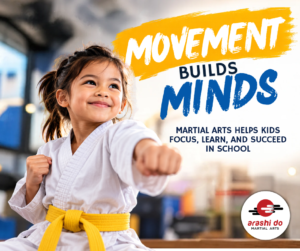
What if one of the best ways to help your child succeed in the classroom is to get them moving outside of it?
As parents, we want our children to succeed in school. We encourage reading, help with homework, establish routines, and look for ways to improve their concentration. But one important part of learning often gets overlooked: physical activity.
Research suggests that movement does more than improve physical fitness. Regular exercise can support the development of attention, working memory, self-control, and other cognitive skills that children use every day in the classroom.
At Arashi-Do Martial Arts, we believe that strong bodies and focused minds go hand in hand. Through Karate, Muay Thai, or Brazilian Jiu-Jitsu, children have opportunities to develop physical skills while practising the focus, discipline, and perseverance that support learning and personal growth.
The Connection Between Movement and Learning
Children aren’t designed to sit still all day. Their growing bodies need opportunities to move, explore, and develop new skills. Interestingly, their developing brains benefit from physical activity, too.
Researchers have found that regular physical activity can positively influence executive function, a group of mental skills that help children manage their thoughts, emotions, and actions.
These skills include:
- Focus and attention: Staying engaged with a task, even when distractions are present.
- Working memory: Remembering instructions and using information to complete an activity.
- Self-control: Managing impulses, emotions, and behaviour.
- Cognitive flexibility: Adapting when circumstances change or something doesn’t go as planned.
- Problem-solving: Thinking through challenges and finding solutions.
A 2018 meta-analysis published in the Journal of Science and Medicine in Sport examined 31 studies involving children aged 6 to 12. Researchers found that physical activity had positive effects on executive function, attention, and certain measures of academic performance. The strongest benefits were generally associated with regular physical activity sustained over time. PubMed
These findings reinforce an important message for parents: physical activity isn’t simply a break from learning. It can help develop the skills children need to learn.
Why Movement Matters for Reading and Academic Success
Learning to read involves much more than recognizing letters and sounding out words. Children must concentrate, remember information, follow sequences, and make connections between what they already know and what they’re learning.
When children struggle to maintain attention or remember instructions, classroom activities can become more challenging. Physical activity offers one way to support the development of these underlying cognitive skills.
A comprehensive scientific review published in 2016 examined research involving physical activity, fitness, cognitive function, and academic achievement in children. The researchers found encouraging evidence that physical activity can benefit cognitive functioning, although its effects on academic results vary across studies. PubMed
This doesn’t mean exercise automatically improves reading scores or replaces dedicated literacy instruction. Instead, it highlights how movement can contribute to a child’s overall readiness to learn.
For parents, the takeaway is simple: helping children stay physically active is another meaningful way to support their development, alongside reading, quality sleep, good nutrition, and positive learning experiences.
How Martial Arts Combines Physical Activity With Mental Engagement
Not all physical activities challenge the brain in the same way.
Running, cycling, swimming, and playing outside offer valuable physical benefits. Martial arts adds another dimension by combining movement with concentration, memory, coordination, and decision-making.
During a martial arts class, children aren’t simply exercising. They’re listening to instructions, remembering movement sequences, responding to changing situations, and learning to control their actions.
This combination of physical movement and mental engagement creates opportunities to practise skills that extend beyond the dojo.
A 2021 systematic review of randomized controlled trials found that physical activities involving coordination, cognitive engagement, and social interaction showed promising benefits for children’s cognitive functioning. PubMed
At Arashi-Do, our Karate, Muay Thai, and Brazilian Jiu-Jitsu, programs naturally incorporate many of these elements.
Karate: Building Focus, Memory, and Self-Discipline
Karate encourages children to pay attention to details, follow instructions, and practise movements with intention.
Learning a new technique or sequence requires children to listen carefully, remember what they’ve been taught, and coordinate their movements. As students progress, they learn that improvement comes through repetition, patience, and consistent effort.
For a child who struggles with focus, Karate provides opportunities to practise concentrating on one task at a time in a structured, supportive environment.
The lessons extend beyond physical techniques. Children learn to respect their instructors, take responsibility for their actions, and understand that progress requires commitment.
The classroom connection: Listening, remembering instructions, staying focused, and completing tasks are valuable skills both on the mats and at school.
Muay Thai: Developing Coordination, Attention, and Confidence
Muay Thai combines physical movement with timing, coordination, and quick decision-making.
Children learn to follow combinations, respond to instructions, and coordinate their hands and feet while maintaining control over their movements.
As students become more comfortable with new skills, they also develop confidence in their ability to take on challenges.
Muay Thai provides an active environment where children can direct their energy toward learning something new. Rather than expecting children to remain still, classes encourage purposeful movement while reinforcing the importance of attention and self-control.
The classroom connection: Following multi-step instructions, managing energy, adapting to challenges, and maintaining concentration can support positive learning habits.
Brazilian Jiu-Jitsu: Encouraging Problem-Solving and Perseverance
Brazilian Jiu-Jitsu (BJJ) offers a particularly interesting combination of physical activity and strategic thinking.
Students learn to assess situations, anticipate movements, and make decisions based on what is happening around them.
Unlike activities that rely primarily on memorized sequences, BJJ frequently challenges children to adjust their approach when their first attempt doesn’t work. This encourages flexibility, patience, and persistence.
Children also learn that making mistakes is a normal part of improvement. They practise staying calm, trying different approaches, and working through challenges rather than immediately giving up.
The classroom connection: Problem-solving, flexible thinking, emotional regulation, and perseverance are important skills when children encounter difficult schoolwork.
Why Consistency Matters More Than a Single Class
One of the most important findings in research on physical activity and cognitive development is the potential value of consistency.
A 2024 systematic review and meta-analysis found that aerobic exercise improved several aspects of children’s executive function, including working memory, inhibitory control, and cognitive flexibility. However, the evidence for improvements in academic performance was less consistent, and the researchers emphasized the need for stronger studies. PubMed Central (PMC)
For families, this reinforces the value of building sustainable habits rather than looking for immediate results.
Martial arts offers children a structured activity they can return to week after week. With each class, students have opportunities to practise listening, concentrating, following instructions, and managing challenges.
At Arashi-Do, we encourage students to focus on personal progress rather than comparing themselves to others. Every new skill learned, every challenge overcome, and every class attended represents another opportunity for growth.
Success isn’t always about getting something right the first time. Often, it’s about learning to keep trying.
Helping Kids Manage Energy After School
After spending much of the school day sitting, listening, and concentrating, many children are ready to move.
Parents may notice that their children become restless, distracted, or frustrated after school. This doesn’t necessarily mean they’re misbehaving. They may simply need an opportunity to be physically active and transition away from the demands of the classroom.
An after-school martial arts class provides a structured outlet for movement while introducing a different type of learning experience.
Children can release energy through physical activity, connect with other students, and focus their attention on achievable goals.
For some children, this transition can make the after-school routine more enjoyable. Instead of moving directly from classroom work to homework, they have an opportunity to engage in an activity that challenges them physically and mentally.
Martial arts can also offer something increasingly valuable in a screen-focused world: an opportunity to interact face-to-face, develop friendships, and build confidence through real experiences.
Building Confidence That Goes Beyond the Dojo
Academic success involves more than remembering information and completing assignments. Children also need the confidence to ask questions, attempt unfamiliar tasks, and recover when something doesn’t go as planned. These qualities develop through experience.
In martial arts, children regularly encounter challenges that initially seem difficult. A new Karate sequence might require several attempts. A Muay Thai combination might take time to coordinate. A Brazilian Jiu-Jitsu technique might require students to rethink their approach.
With guidance, encouragement, and practice, students discover that they can improve.
A child who learns to approach challenges with patience and determination in martial arts may begin applying that same mindset to other areas of life.
At Arashi-Do, our instructors encourage children to celebrate effort, recognize progress, and develop confidence in their abilities.
The goal isn’t perfection. It’s helping students understand that learning is a process and that challenges are opportunities to grow.
More Than Exercise: Developing Skills for Life
Parents often enrol their children in martial arts because they want them to become more active, improve their fitness, or learn a new skill. What they may discover is that martial arts offers opportunities for much more.
Through regular training, children practise habits that can support their development at home, at school, and in their relationships with others.
They learn to listen before acting, show respect for others, work toward goals, and manage frustration when things become difficult. They also discover the satisfaction of accomplishing something through their own effort.
These experiences don’t guarantee better grades or eliminate challenges with attention and learning. However, they can complement the work parents and teachers are already doing to help children develop into capable, confident individuals.
When children develop stronger habits, greater confidence, and a willingness to learn, those benefits can reach far beyond the mats.
Give Your Child the Opportunity to Move, Learn, and Grow
Every parent wants to give their child the tools to succeed.
Reading together, encouraging curiosity, supporting schoolwork, and establishing healthy routines all play important roles in that process. Physical activity deserves a place on that list, too.
Research continues to demonstrate meaningful connections between movement, cognitive development, and the skills children use for learning.
At Arashi-Do Martial Arts, we bring physical activity, mental engagement, and personal development together through our Karate, Muay Thai, and Brazilian Jiu-Jitsu programs.
Confidence Starts on the Mats. Success Follows Everywhere Else.
Discover how Arashi-Do Martial Arts can support your child’s growth through structured, engaging, and age-appropriate training.
Book a FREE Trial Class Today!
Visit Arashi-Do Martial Arts to find a location near you and get started.
Can martial arts help my child focus better in school?
Martial arts provides opportunities for children to practise concentration, listening, memory, and self-control. Research suggests that regular physical activity can support executive function and attention, which are important for learning. While improvements vary from child to child, structured martial arts classes can complement the development of positive classroom habits.
How does physical activity support children's learning and reading skills?
Physical activity can support cognitive functions such as working memory, attention, and inhibitory control. Children use these abilities when following instructions, recognizing patterns, remembering information, and completing reading activities. Although exercise doesn’t directly teach children to read, it may support some of the underlying skills involved in learning.
Which martial art is best for improving focus and discipline?
Karate, Muay Thai, and Brazilian Jiu-Jitsu all provide opportunities to develop focus and discipline. Karate emphasizes structured movements and repetition, Muay Thai combines coordination with attention and timing, and Brazilian Jiu-Jitsu encourages strategic thinking and problem-solving. The best choice depends on your child’s interests, personality, and the type of activity they enjoy.
Can martial arts help children who have trouble sitting still?
Martial arts offers an active, structured environment where children can direct their energy toward learning new skills. Classes combine movement with listening, following instructions, and practising self-control. Many families find that having a positive outlet for physical activity is a helpful addition to their child’s routine.
How often should children attend martial arts classes to experience benefits?
Consistency is important for developing physical skills, confidence, and positive habits. Attending classes regularly gives children opportunities to practise what they’ve learned and build on previous experiences. The ideal frequency depends on the child’s age, interests, schedule, and individual needs.
Find a Location Near You
With multiple locations across Calgary, it’s easy to get started:
- SE Calgary – Acadia
- SW Calgary – Rutland Park
- NE Calgary – Deerfoot North – McCall Lake
- SE Calgary – Douglasdale
Book a free trial to discover martial arts-based self-defense.
Try a Free Karate Class in Calgary
Try a Free Muay Thai Class in Calgary
Try a Free Brazilian Jiu Jitsu Class in Calgary
Book your free trial at your nearest Arashi-Do location.
Calgary North: 403-612-4050 | Calgary South: 825-747-9574 | Calgary Southwest: 825-747-9574 | Calgary Southeast: 403-612-4050 | Calgary West: 403-990-0482
Explore our Karate, Muay Thai, and Jiu-Jitsu programs!
Research References
- de Greeff et al. (2018)
Effects of physical activity on executive functions, attention and academic performance in preadolescent children: a meta-analysis.
Journal of Science and Medicine in Sport.
Read the research - Donnelly et al. (2016)
Physical Activity, Fitness, Cognitive Function, and Academic Achievement in Children: A Systematic Review.
Medicine & Science in Sports & Exercise.
Read the research - Zang et al. (2024)
Effects of aerobic exercise on children’s executive function and academic performance: A systematic review and meta-analysis.
Heliyon.
Read the research - Systematic Review (2021)
Does Physical Activity Improve Cognition and Academic Performance in Children? A Systematic Review of Randomized Controlled Trials.
Read the research